Why are Rise and Storyline courses slow to load?
On a slow 4G connection, three public Storyline courses showed their main content after 14.6 to 24.3 s, three public Rise courses after 14.5 to 23.6 s, and four Elabora examples after 2.8 to 3.6 s. Most of the gap is a fixed cost of each tool: before the first picture, Rise loads 10 font files and 1.5 to 1.7 MB of JavaScript, Storyline 0.8 to 1.2 MB of JavaScript, Elabora 0.14 to 0.38 MB. The same small module made in all three tools confirms it: Elabora showed its first screen in 2.3 to 2.4 s, Storyline in 9.8 s, and Rise its first text in 9.9 s. On fast fibre, every course showed within 5 s.
The short answer
We opened 10 public courses as a learner opens them, with an empty cache, on a slow 4G connection (Lighthouse’s profile) and a processor slowed 4 times: the situation of a learner on the move, in the countryside, or on a busy work laptop.
| Slow 4G, processor ×4 | Storyline (3 courses) | Rise (3 courses) | Elabora (4 examples) |
|---|---|---|---|
| Main content shown (LCP) | 14.6 to 24.3 s | 14.5 to 23.6 s | 2.8 to 3.6 s |
| JavaScript transferred | 0.84 to 1.21 MB | 1.45 to 1.67 MB | 0.14 to 0.38 MB |
| Everything transferred until the page is quiet | 2.8 to 10.7 MB | 3.8 to 4.2 MB | 0.3 to 0.7 MB |
- Full colour: the same module, made in each tool
- Light: a course published by its author
Medians of 3 runs per course, measured from France on 6 November 2026.
What the learner sees
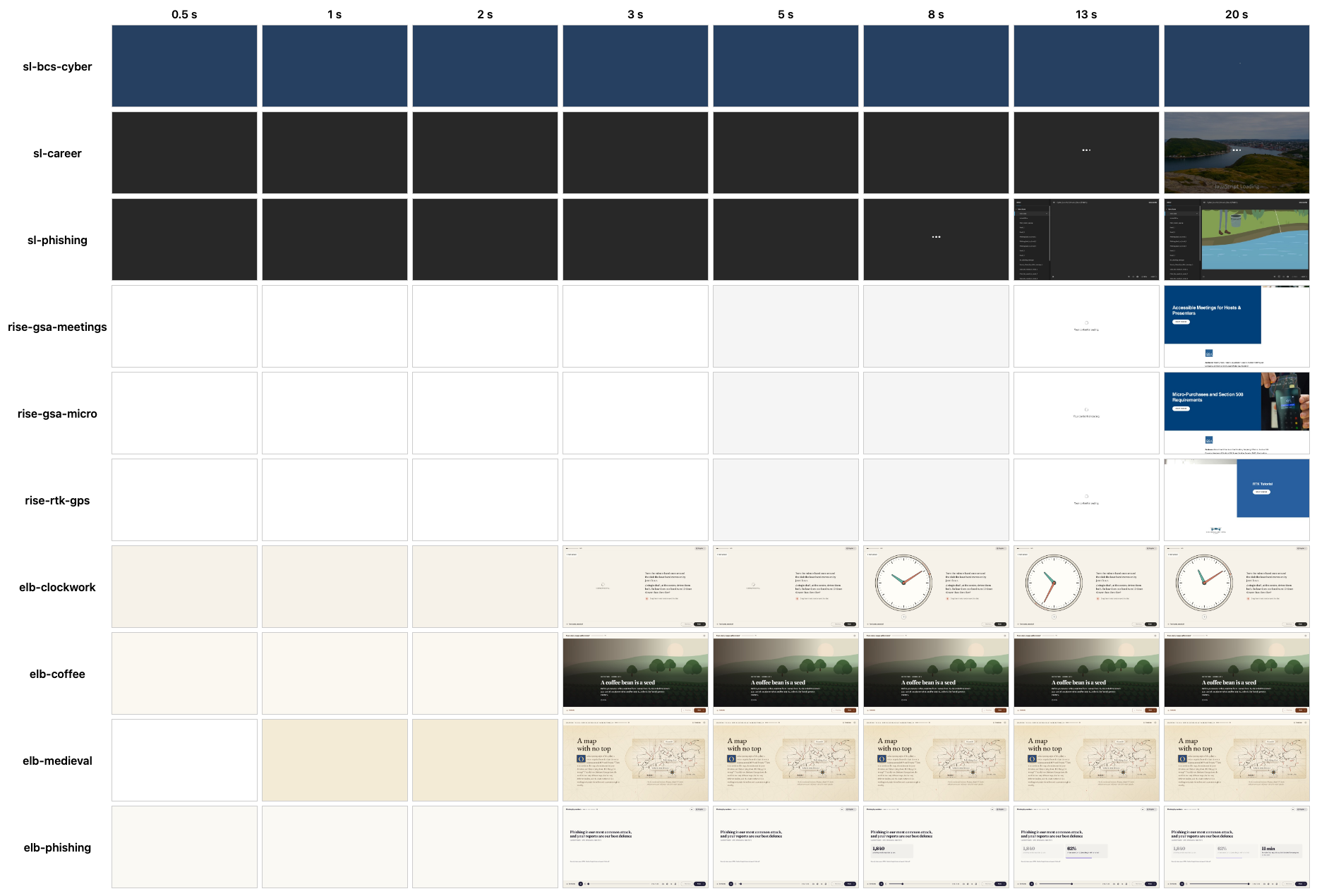
One row per course, named by its id in the raw data, one column per moment, on slow 4G; open the image to see it full size. The Storyline courses stay on a dark screen, then three dots, until 13 s or later; one is still dark at 20 s. The Rise courses stay on a white page, then show “Your content is loading” at 13 s and their first screen by 20 s. The Elabora examples show their first screen at 3 s; Medieval charts has no picture at 0.5 s, where its page was still blank. (Screenshots slow a page down a little: the figures come from runs without them.)
Why: a fixed cost in each tool
Before the first picture, each tool loads its own player. That cost barely depends on the course.
| Course | JavaScript | Fonts | Stylesheets | Pictures and media |
|---|---|---|---|---|
| Storyline · Phishing attempts | 841 KB | 63 KB | 326 KB | 663 KB |
| Storyline · Career profile | 1,045 KB | 63 KB | 852 KB | 8,643 KB |
| Storyline · BCS cyber | 1,212 KB | 63 KB | 1,995 KB | 3,520 KB |
| Rise · RTK GPS | 1,668 KB | 1,945 KB | 133 KB | 76 KB |
| Rise · Micro-purchases | 1,453 KB | 2,301 KB | 119 KB | 119 KB |
| Rise · Accessible meetings | 1,637 KB | 2,301 KB | 119 KB | 129 KB |
| Elabora · Phishing by numbers | 161 KB | 79 KB | 59 KB | 207 KB |
| Elabora · Clockwork | 381 KB | 71 KB | 61 KB | — |
| Elabora · Coffee in brief | 140 KB | 97 KB | 55 KB | 10 KB |
| Elabora · Medieval charts | 151 KB | 93 KB | 73 KB | 32 KB |
Bytes transferred without throttling, compressed as the servers send them.
- Rise loads 10 font files (1.9 to 2.3 MB) and 1.5 to 1.7 MB of compressed JavaScript, 5 MB once decompressed, before it shows anything. On disk, the library of a Rise web export weighs about 11 MB, 8.5 MB of it JavaScript, even for a course of three blocks (seven exports of 2025 and 2026). Articulate’s staff acknowledge that “Rise 360 courses can take a few seconds to initialize” (E-Learning Heroes, 6 November 2025).
- Storyline loads 0.8 to 1.2 MB of JavaScript (3 to 5 MB decompressed) and its stylesheets, then preloads the next slides’ pictures and media: its weight depends on the course. The library of a Storyline export weighs about 3 MB.
- Elabora’s player weighs about 0.4 MB on disk; the examples load 0.14 to 0.38 MB of JavaScript.
The same module in all three tools
The courses above differ in size and media. So we also built the same small module in all three tools: a title, a 70-word text, one picture, 30 seconds of narration and three questions, with the same files and each tool’s default settings, served by the same local server. Storyline 360 3.129 and Rise 360 published it on 6 November 2026, with an Articulate 360 trial; Elabora built it twice, as slides to face Storyline and as a scrolling page to face Rise.
| Slow 4G, processor ×4 | Storyline | Elabora, slides | Rise | Elabora, scrolling page |
|---|---|---|---|---|
| First text shown (FCP) | 9.8 s | 2.4 s | 9.9 s | 2.3 s |
| Full first screen (LCP) | 9.8 s | 2.4 s | 25.0 s | 2.3 s |
| Fixed cost, before the module’s content | 0.78 MB | 0.19 MB | 3.55 MB | 0.19 MB |
| Everything transferred | 1.12 MB | 0.53 MB | 3.95 MB | 0.29 MB |
Medians of 3 runs. Rise’s full first screen waits for the cover image it adds by default; served over HTTP/1.1, its 39 requests also queue.
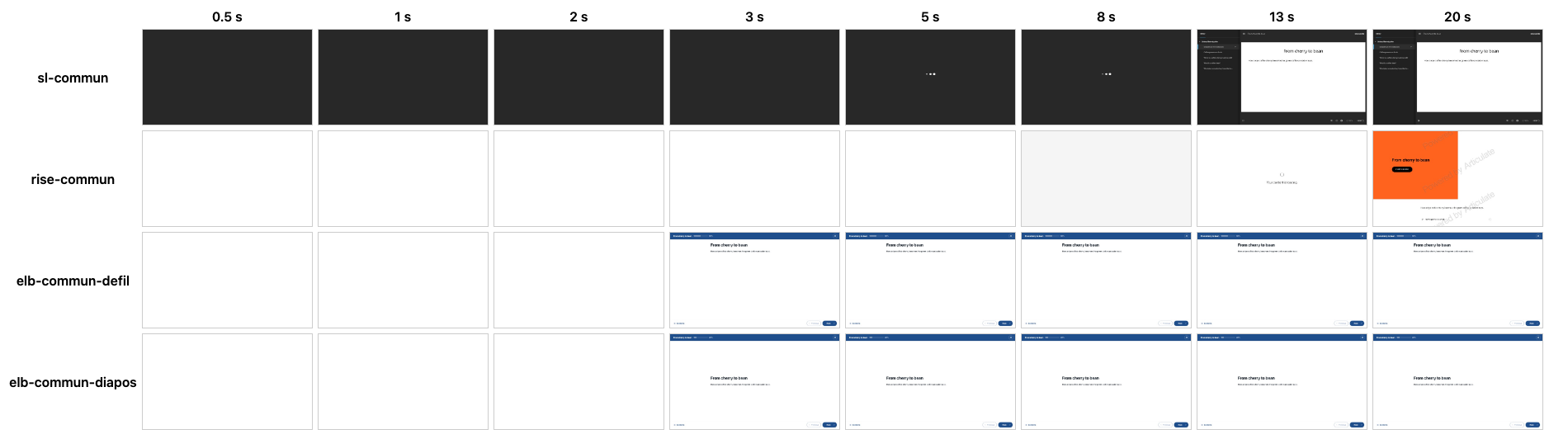
Both Elabora versions show their first screen at 3 s. Storyline shows three dots from 5 s and its first slide at 13 s. Rise shows a spinner at 13 s and its title page at 20 s, its cover image still on its way.
Before any of the module’s own content, Rise loaded 3.55 MB (1.9 MB of it in 10 font files), Storyline 0.78 MB and Elabora 0.19 MB. That fixed cost comes with every course the tool publishes, however small.
- JavaScript
- Fonts
- The rest
| Tool | Fixed cost | JavaScript | Fonts | Stylesheets |
|---|---|---|---|---|
| Storyline | 0.78 MB | 624 KB | 63 KB | 89 KB |
| Rise | 3.55 MB | 1,468 KB | 1,944 KB | 133 KB |
| Elabora | 0.19 MB | 136 KB | system fonts | 52 KB |
On disk, the web exports weigh 3.7 MB for Storyline (28 files), 12.8 MB for Rise (62 files) and 1.1 MB for Elabora (17 files).
Without throttling, all three opened in under a second on the same computer: Elabora in 0.1 s, Rise in 0.6 to 0.9 s, Storyline in 0.8 s.
What differs between the three modules, and weighs little:
- Rise’s free trial puts a watermark on the title page, visible on the film strip.
- Rise’s cover image, added by default (1,920 × 1,080, 407 KB), is the largest element of its title page, so its LCP; it is counted outside the fixed cost.
- Captions: Storyline adds captions to the narration (2 KB); Elabora makes its own (0.8 KB).
- The media: each tool re-encodes them its own way. Rise turns the narration into a 160 kb/s stereo MP3 (607 KB), Storyline into a 56 kb/s MP3 (213 KB); Elabora keeps the 64 kb/s track. Storyline keeps the picture as it is (102 KB), Rise recompresses it (37 KB).
- Fonts: Elabora’s default theme uses the system’s fonts; a course with its own fonts adds them, 70 to 100 KB in our examples. Its player also carries its interface sounds (69 KB).
- The questions: in Storyline and Rise, the first answer was marked correct in questions 2 and 3, which changes nothing in the weight.
This measurement adds to the one of real published courses; it does not replace it. Both point the same way.
On a fast connection
Without throttling, on fibre, the gap narrows: every course showed its content within 5 s.
| Unthrottled | Storyline | Rise | Elabora |
|---|---|---|---|
| Main content shown (LCP) | 0.6 to 1.7 s | 1.1 to 4.4 s | 0.6 to 1.0 s |
Unthrottled, the first paint varies by 0.1 to 0.3 s with the network of the moment. The difference shows with a slow network or a modest processor, which is where many learners are.
How to make a Rise course lighter
- Break long lessons with Continue blocks. Authors report that Rise loads a whole lesson at once, and that a Continue block splits what loads first (Optimize Rise 360 lesson size, October 2025; an author’s finding, not Articulate’s documentation).
- Compress pictures and videos before you add them. Export photos as JPEG or WebP at the size they show, and videos at a bitrate made for the web.
- Duplicate the course to drop old media. A SCORM package can keep the media of earlier versions of a course; duplicating the course leaves them behind (October 2026 thread).
- Check the package after a translation. One author’s package reached 741 MB after translating the course, and the LMS refused it (August 2026 thread).
- Test outside your LMS. Upload the package to SCORM Cloud: if it loads quickly there, look at the LMS and its player.
The fonts and the JavaScript of Rise’s player stay: they are its fixed cost.
How to make a Storyline course lighter
- Lighten the first slides’ media. Storyline preloads the next slides: the Career profile course transferred 8.4 MB of pictures before the page was quiet.
- Lower the publishing quality. In the publish settings, choose the video quality, the audio bitrate and the JPEG quality that fit your learners’ connection.
- Test outside your LMS, in SCORM Cloud or Review 360, to see what comes from the LMS.
What to know about Elabora’s figures
- A course weighs what its media weigh. Elabora loads it progressively: the first screen first, then the pictures and narration of what follows as the learner goes on. So learners see their content quickly, even with heavy media.
- One example keeps the processor busy in this measurement. Clockwork’s animated clock, drawn with WebGL, blocks the page for 295 ms on the slowed processor: Chrome without a GPU reads every WebGL frame back to the processor. With a Mac’s GPU, no long task comes after 1.3 s.
- The Elabora examples are ours, made to show what Elabora does, and measured as published on its showcase.
How we measured
- The courses. 10 public courses, open without an account: three Storyline 360 courses (versions 3.102 and 3.105, published between August 2025 and September 2026) and three Rise 360 courses (2026), published by their authors on GitHub Pages and section508.gov, and four Elabora examples on its showcase. Each is linked in the table above.
- When. On 6 November 2026: the Storyline and Rise courses, Phishing by numbers and Coffee in brief at 12:49 UTC; Clockwork and Medieval charts at 14:45 UTC.
- The browser. Chromium 151 without a GPU, a 1,366 × 768 window, the user agent of desktop Chrome.
- Throttled. Lighthouse’s slow 4G profile, applied by Chrome to every request (562.5 ms round trip, 1,474.56 kbit/s down, 675 kbit/s up), and the processor slowed 4 times. Unthrottled: the computer’s fibre.
- An empty cache on every run, after one uncounted load that wakes each CDN up. Three runs per course and condition, course after course; we keep the median.
- The end of a run: 5 s without a long task and at most 2 requests in flight, as Lighthouse does, then 1 s more; at most 60 s unthrottled, 180 s throttled. The bytes count until then: the first screen and what the tool loads ahead, not the whole course.
- The figures: bytes transferred by type (Chrome’s DevTools protocol), FCP and LCP (the browser’s API), when the page can be used (TTI, as Lighthouse computes it), the total blocking time, the main thread’s busy time.
- The computer: an Apple M5 Mac with 10 cores and 16 GB, busy with other work during the runs (its load is noted on each run). Throttled times varied by 0.4 s at most from one run to the next: the network dominates.
- The same module in all three tools was served by the script from that one computer, over HTTP/1.1 with gzip (its load was 8 to 16), on 6 November 2026 at 14:56 UTC: Storyline 360 3.129.38633.0 and Rise 360 web exports with their proposed settings, and Elabora built from elabora-core bb4ce638.
What this study leaves out:
- The courses differ in size: 6 to 63 slides for Storyline, 58 to 84 blocks for Rise, 4 to 13 screens for Elabora. The first screen depends little on it, the total weight a lot. The same module made in all three tools (above) removes that reservation for the first screen, and keeps the same order.
- The media follow each author’s choices.
- The hosts differ (GitHub Pages, section508.gov, Cloudflare); the same module, served from one computer, removes that difference.
- Throttling is simulated by Chrome, not a real mobile network.
- Web exports, not an LMS: an LMS adds its own player to all three.
The script and the raw numbers
The script, the list of courses and every run are public, in research/load-speed of this site’s repository. The shared module’s runs and film strips are there too; its Storyline and Rise exports stay unpublished, since they carry Articulate’s code and details of the author’s account. Run the script again, on your courses too:
node research/load-speed/measure.ts --mode live --runs 3Elabora’s limits today
We list them on every comparison. They are what we work on first.
- Importing Storyline and Rise courses is in beta. Some question types, triggers and interactions come over as text with a note, and the import report lists each one.
- A young tool: the first public version came out on 20 October 2026, and Elabora is in beta. Expect fewer tutorials and community answers, and a new version every few days.
- One author per course for now. Co-authoring and shared team spaces come later, with Elabora’s cloud.
- A smaller library: 7 templates and starter blocks, and no stock library of photos or characters. Your AI makes illustrations, backdrops and layouts to measure for each course.
Questions
- How heavy is a Rise course?
- The three Rise courses we measured transferred 3.8 to 4.2 MB before the learner could use them, of which 3.4 to 3.9 MB were JavaScript and fonts: almost the same for 58 blocks as for 84. A nearly empty Rise course we made loads 3.55 MB before its own content, 1.9 MB of it in fonts. On disk, the library of a Rise web export weighs about 11 MB, 8.5 MB of it JavaScript, even for a course of three blocks.
- Is my LMS the cause, or the course?
- Both can add time. We measured web exports opened directly, without an LMS. To tell them apart, upload the same package to SCORM Cloud: if it is slow there too, the course is the cause.
- Do heavy media slow an Elabora course down?
- A course weighs what its media weigh. Elabora loads it progressively: the first screen first, then the pictures and narration of what follows as the learner goes on. So learners see their content quickly, even with heavy media: Medieval charts, a course of large maps, shows its content in 3.6 s on slow 4G.
Try Elabora on your computer. It’s free.
Download Elabora